“Dear, I’ve had enough. I do not understand what is trying to happen? How is it possible that we trigger each other so much? When will this ever end?” I (Kavitha) collapsed onto the floor, my body giving way to overwhelming exhaustion. I turned to Kester, hoping he might have an answer. Instead, I noticed him withdrawing, with tension etched into his posture and knots of frustration tightening across his back.
Relationship Disharmony – A Common Occurrence
Relationship disharmony, is a rather common occurrence. I’ve had such experiences with my mother, my son and at times with my closest friends. During a 1-1 session, my client complained, contemplating if she should bring her friend for therapy too: “It’s as if I don’t exist at all. It hurts me to see my closest friend completely ignore me. I understand that she just started dating and a new relationship requires more time. But how can she just throw away all that we’ve built for years?”
In the early days of our relationship, Kester and I tried every material we could find on avoiding triggers in a relationship–we had ‘time-offs’, took long walks, focused on breathing, and even worked with a mentor. These worked–temporarily–and then the triggers got activated again. This time, things came out screaming louder than before.
Tired of these repeated U-turns, in one of those deep moments of despondency, Kester asked, “Should we try something different?” I looked at him and let out a deep sigh of relief. It turned out that "something different" meant standing tall and facing our triggers with courage.
Facing Triggers Together
Over the next few years of facing our triggers, Kester and I learnt that relationships act as mirrors. When you are triggered because of something your partner has said or done, it reveals a part in you that you may not be aware of, similar to how a mirror reflects your physical appearance. This triggered part of you may be a childhood belief system that has been questioned, or an unresolved wound from your past that your partner's behaviour has now resurfaced in you. The clearer and more honest we are with ourselves, the healthier and more thriving our relationships become.
Practically What Does This Mean?
Let’s say you’re triggered by something your partner or friend did or said. This sets off an emotional reaction in you, think along the line of anger, frustration, or guilt. This emotional reaction you feel called is ‘trigger’.
In an unconscious person the trigger hijacks the mind. The hundreds of good and positive things the person in question has said or done is forgotten, and a file that holds memories of all the negative things is activated. With this ‘ammunition’, the trigger starts to frame your partner or friend so it can ‘hide its tracks’.
A conscious person on the other hand, notices the emergence of a trigger and self-sits to enquire into the narrative that is being fed into the mind. They are bluntly honest with themselves. They sit with the trigger, ask self-inquiry questions, and deep listen to unearth hidden patterns. Only after they have gained sufficient self-awareness do they engage in a constructive conversation with their partner or friend, about what can be done differently next time.
The SACRED Relationship FrameworkTM
Now you bring two therapists together, individuals who believe in the power of facing triggers and growing from it, the result is the birth of a framework that enables people like you to develop the skill sets needed become conscious during triggers and to build thriving, sacred relationships.
We named this framework The SACRED Relationship Framework—or SRF for short, embracing Singapore’s love for acronyms. Learn more about the Framework here.
Demonstration of the Framework in Action
As relationship mentors, we often get questions such as: “How do I know if I am being vulnerable and expressing my feelings vs. when I am hurting the other with my emotions?”
The key is EMPOWERMENT (one of the pillars of the SRF). Are you taking responsibility for your triggers and parts in pain, or giving your power away by expecting your partner to take responsibility of your healing?
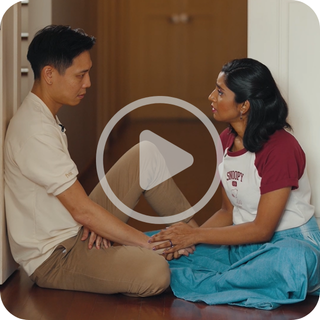
In this video, Kester demonstrates how it looks like to move from being dependent on the other to hold space for one’s pain, to taking responsibility.
We also get questions such as: “When I am supporting someone, how do I know if I am giving in to their emotions vs. really supporting their healing?”
This is where EMPOWERMENT means coming back to yourself and discerning when you are responding to them from a space of desperateness, helplessness, defensiveness, or from a space of deep presence and connection.
In the same video, Kavitha demonstrates what holding space from deep love and presence looks like.
Growing with Triggers – Simple Exercise
Raising awareness of self is a skill set that required consistent practise. Often times we may think, when I have an issue or challenge, then I will think what to do with it. This is equal to saying, “when I am drowning, I will learn to swim.” Just like swimming is a skill that requires investing consistent time to learn and practise, building thriving relationships is a skillset that can be learnt over time.
Here is a simple exercise to get you started:
Step 1
Set aside one minute every day
Step 2
Sit down, in a space where you won’t be disturbed for a minute. A notebook might come in handy for the next steps. Avoid using a phone of digital devises as these may distract you.
Step 3
Take a couple of deep breaths to relax yourself.
Here is a breathing pattern Kester and I find useful. Do 4-5 sets.
Box breathing: Breathe-in 4 counts, hold breath 4 counts, exhale 4 counts.
Step 4
Simply, observe the thoughts that come to your mind; Remember you are just an observer, you are not controlling or thinking the thoughts.
Step 5
Write down the thoughts as they come to mind as a stream of consciousness without filter. If your mind is blank, just write that your mind is blank. If you are thinking “this is so hard”, write that down. The objective is to switch from being the “thinker” of your thoughts, to becoming the “observer” of your thoughts; when you are the “thinker”, you believe that your thoughts are true and this causes suffering. When you are the “observer”, you become free from being controlled by your thoughts.
Step 6
Read the thoughts to yourself and notice if there is a pattern.
When done consistently, this exercise can increase your awareness levels in moments of triggers significantly.
Want to learn more?
The SACRED Relationship Foundational Course, that starts on 26th July 2025, is a 6-month journey that goes deeper into the fundamentals of building thriving relationships with yourself, your partner, family, friends and work teams. Click here for more information.
Wishing you a Sacred Saturday!
Kavitha
P.S: We would be delighted to hear your thoughts on this newsletter and any suggestions you may have for enhancing future editions. Do write to us at [email protected].