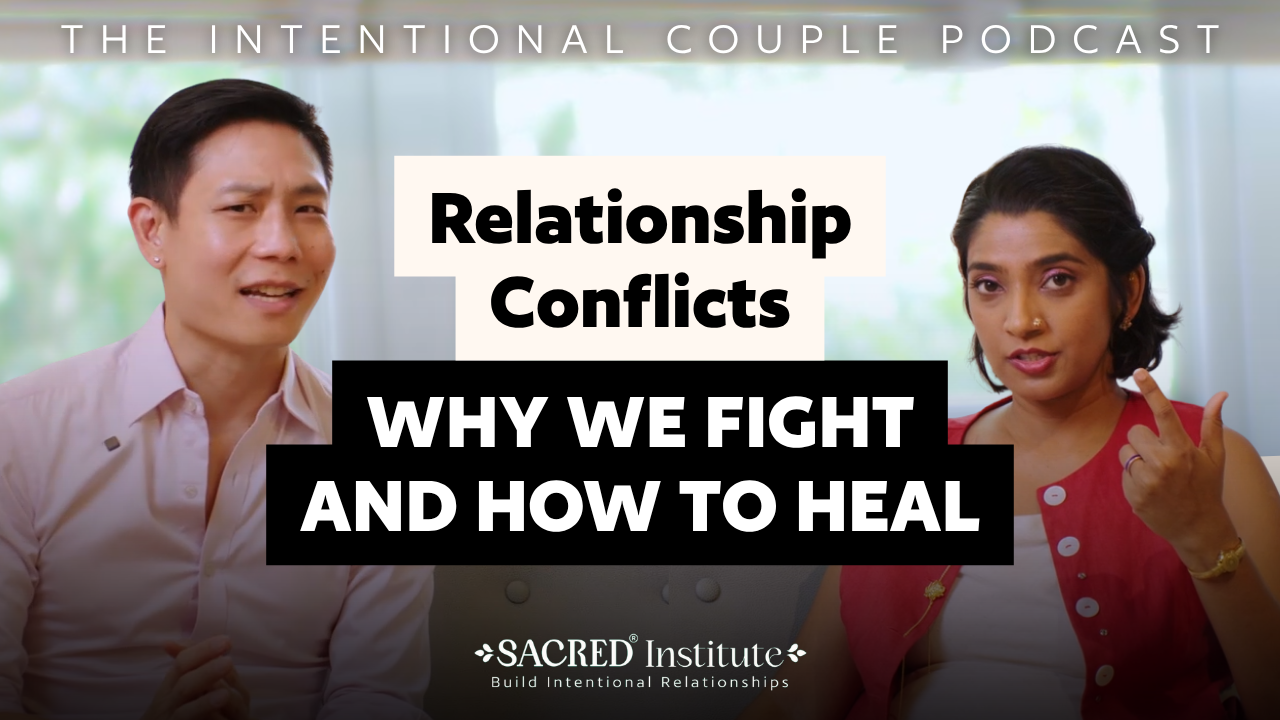
Have you ever felt confused in your relationship?
One moment, your partner is present, understanding, appreciative, accountable.
Then, twenty minutes later, over something small, they're defensive, critical, shutting you out, or treating you like you're the enemy.
And you're left thinking: who am I actually talking to right now?
It feels like there are so many versions of this person. So many sides.
And you're never quite sure which one is going to show up — the one who listens, or the one who's already preparing a defense before you've finished your sentence.
Here's what we can share from our experience: you're not imagining it.
There really are two distinct "voices" showing up in your relationship. And once you learn to tell them apart, you'll approach your relationship challenges with greater clarity and confidence.
Ego Speech vs Awareness Speech
We call the two voices in a person - ego speech and awareness speech.
Ego speech sounds like:
- "Here we go again. How many more times will this repeat?"
- "You always do this."
- "You never listen to me. That's why we're here."
Awareness speech sounds like:
- "I wonder what's trying to happen here."
- "I'm curious to understand your point of view."
- "Here's how I'll show up differently in our relationship."
Ego loves to use absolutes like “never”; “must”; “should”, “always”.
Awareness uses presence. It feels into what the moment needs. It understands that no two situations are the same.
In Ego speech, you listen to defend.
In Awareness speech, you listen to understand.
In unhealthy conflict, Ego is dominant most of the time.
In healthy, intentional conflict, Awareness is present more often than Ego.
In unhealthy conflict, both partners’ Egos are attacking each other. The conflicts spiral out of control.
In healthy conflict, both partners' Awareness is more present than their Ego. There are moments of inquiry:
- “How can I do things differently?”
- “What is my learning from this particular conflict?”
- “What accountability can I as an individual take?”
- “What areas do we need to work on as a couple?”
After an unhealthy conflict, both partners are filled with emotions like anger, hate, and resentment. They partake in actions such giving the cold shoulder, withdrawing into a cave, avoiding the issue and using children as messengers. These actions cause further divide in the relationship.
After a healthy, intentional conflict, despite the presence of emotions like anger, resentment, and sadness, both partners take responsibility for working on improving themselves. They schedule time to talk about the steps they have taken. They constantly show up for each and remain committed to betterment and growth.
(Why do these two voices exist in a person? That's a deeper conversation for another time. If you're curious, reach out to us. For now, it's important to understand the differences between Ego and Awareness, and discern which is more present in your relationship.)
How to Strengthen Awareness
Most couples we meet face this exact confusion — caught between the version of their partner they love, and the version that shows up when triggered.
Deep down, both partners want the same thing: more Awareness Speech, less Ego Speech. They want to repair conflicts in a healthy way, and rebuild their connection.
This shift requires more than just "thinking about it". It requires both partners to take action, learn the right skillsets, and practice.
From our own marriage and working with 1,000+ clients, we know this is true: what you do outside of your conflicts is more important than what you do inside the conflict.
Why?
Because awareness is built during peacetime, not wartime. You cannot build your awareness during a conflict. You can only build awareness when you're not having a conflict.
Building awareness means doing practices to:
- Strengthen your ability to observe yourself,
- To separate yourself from your Ego,
- To observe what thoughts and emotions you're having,
- To go deeper into what those thoughts and emotions mean.
That's why we built the SACRED Relationship Foundational Course to give you the frameworks, the exercises, the mindfulness practices that turn awareness from a nice idea into a daily skill.
In Friendship,
Kavitha and Kester Shekar-Tay
Founders, SACRED® Institute
Creators, SACRED T.R.U.S.T. Method™
P.S. In this week's podcast episode, we explore:
- What unhealthy and healthy conflict actually looks like
- The 4 root causes behind repeating arguments
- A simple exercise to strengthen how you deal with conflicts